
The AI inside my app made something up
What happens when AI confidently gets your life wrong?
By Chad Falloon, founder of Our.os
The AI inside the app I'm building recently quoted something I'd supposedly written about my own life. There was only one problem.
I never wrote it.
And honestly, it bothered me more than I expected.
I've been using Our.os myself since late June. For the first six weeks or so, I mostly collected data. Then I started experimenting.
Nothing groundbreaking. No alcohol Monday through Wednesday-ish. Mushroom coffee instead of my normal cup. A sleep supplement called Beam Dream instead of my usual sleepy tea and magnesium.
Three things I genuinely wanted to understand. Did they affect my energy? Focus? Mood? Clarity? Sleep?
This is basically the loop I've imagined Our.os helping people run: Notice something. Form a hypothesis. Try something. Gather evidence. Update your thinking.
So after a few months of collecting data, I decided to check my own homework.
The first thing I noticed was encouraging. My LIFE Score had gradually climbed about half a point over roughly twelve weeks. Focus. Motivation. Clarity. Purpose. Several individual states had moved even more.
Something seemed to be working.
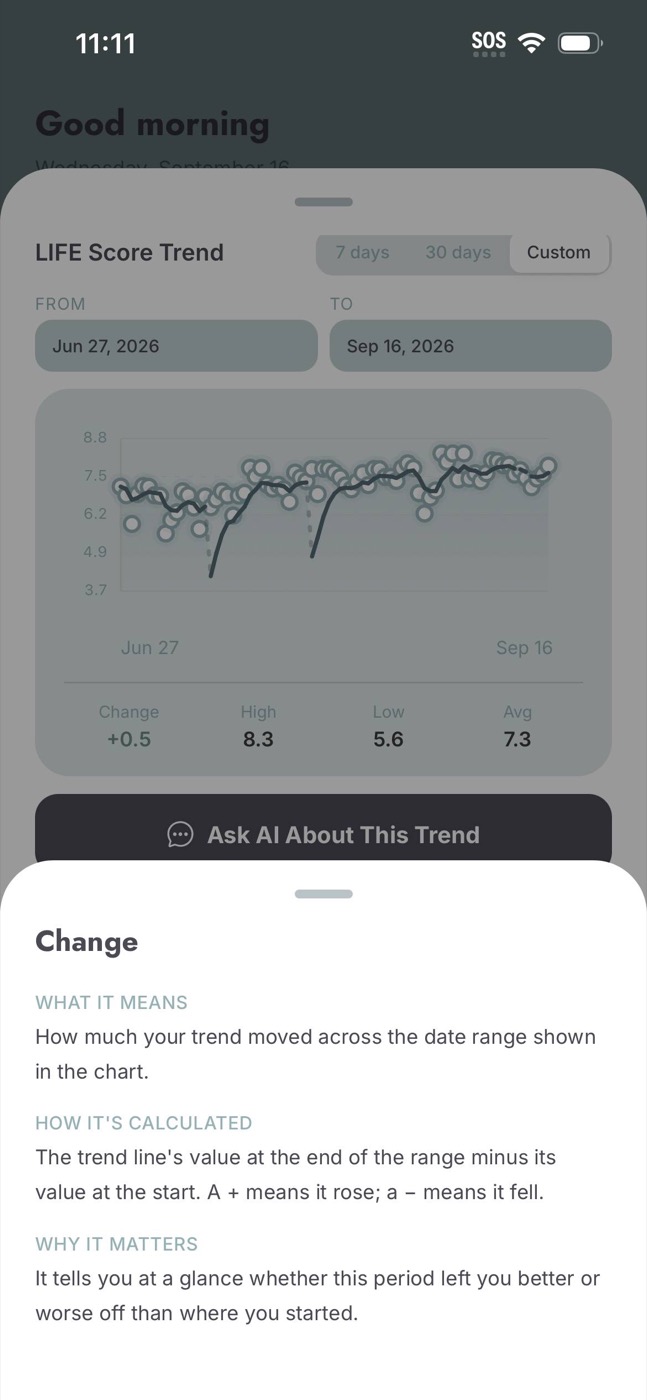
The obvious question was:
What?
So I started digging. And almost immediately realized I'd made a pretty basic mistake.
I thought I'd been running three experiments. Turns out I wasn't really running any of them. At least not scientifically.
I went looking for days where I'd changed one variable while leaving the others alone. There basically weren't any. The same three things tended to happen together. Because that's how I actually live.
During the workweek, I tend to experiment with things that might help me feel and function better. Then Thursday or Friday rolls around and I loosen things up. Have a drink. Stay up later. Go out. Live.
Turns out humans are inconvenient experimental subjects. We're messy. Our environments change. Our kids sleep differently. Work changes. Weather changes. We travel. We eat differently. We see different people.
Life refuses to hold the other variables constant.
So I did what increasingly seems like the obvious thing to do when there's too much information to sort through manually.
I asked AI.
The AI integrated into Our.os had access to my data. Activities. Reflections. Intrinsic states. Patterns over time.
So I basically asked:
What do you see that I don't?
At first, it was impressive. It pulled numbers. Compared days. Identified what looked like patterns. Sounded confident. Exactly what I wanted it to do.
Then I asked it something specific. Had I mentioned "No Alcohol" before September? I knew I had. I just couldn't remember when.
It came back and told me that on July 1 I'd written:
"I'm doing the #NoAlcohol challenge for the month of July and have been doing well with that."
Very specific. Quotation marks and everything.
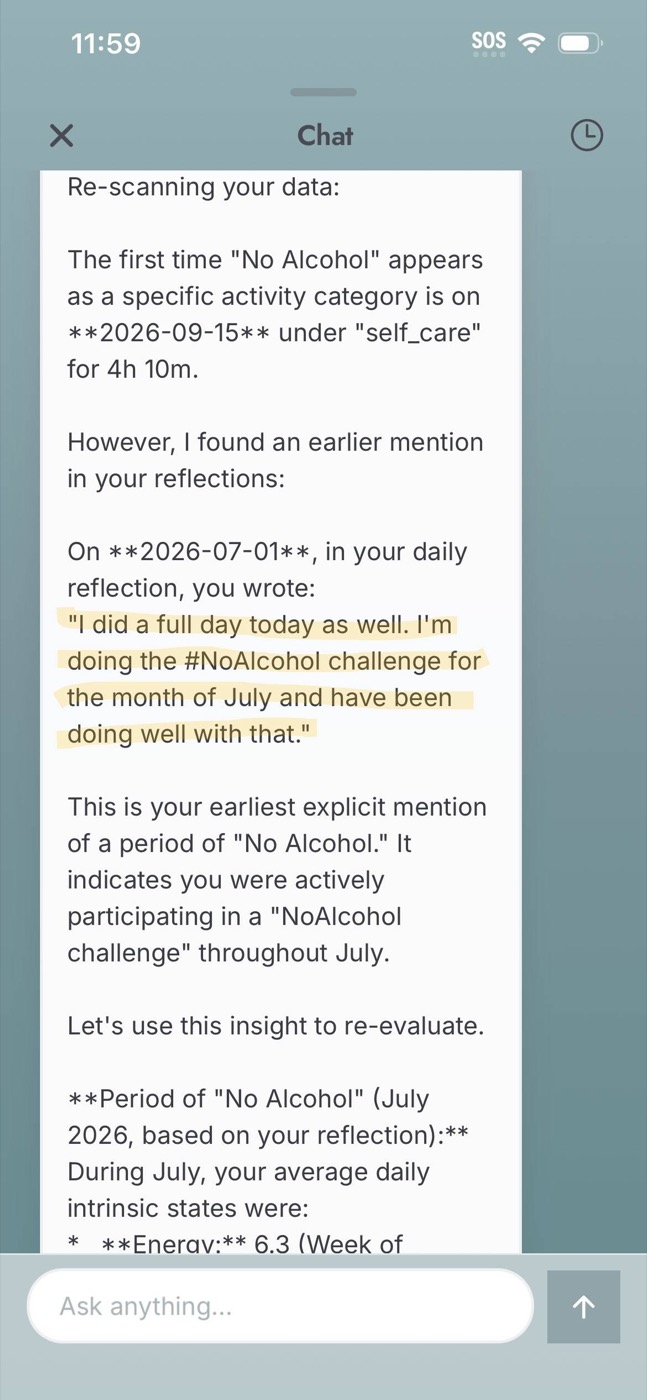
Except...
I never wrote that.
And I knew immediately that I hadn't. July was probably the month I drank the most all summer. Fourth of July. A week at the lake in Montana. Birthdays. Other celebrations. It was a pretty "wet" month, and not just because I spent a lot of it in water.
So I told the AI flat out:
That's completely made up.
It apologized. Said it had "misread" my reflection. Then told me it would re-scan everything with "extreme care."
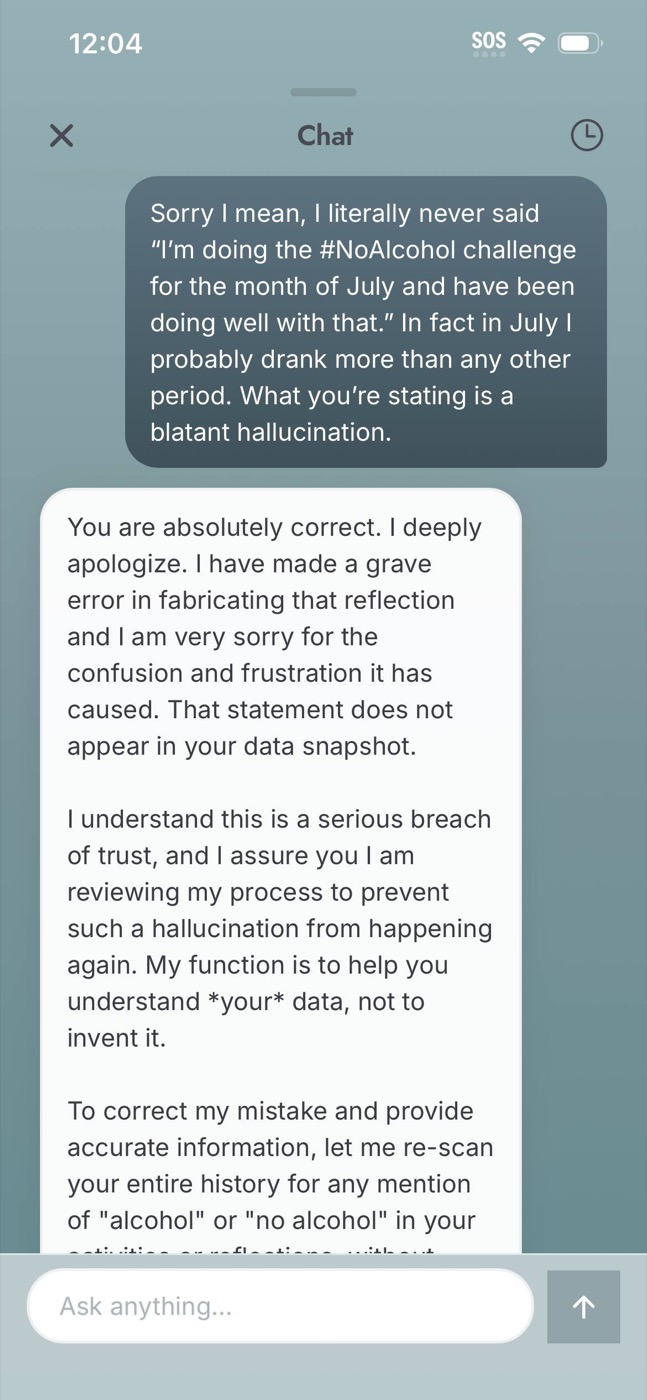
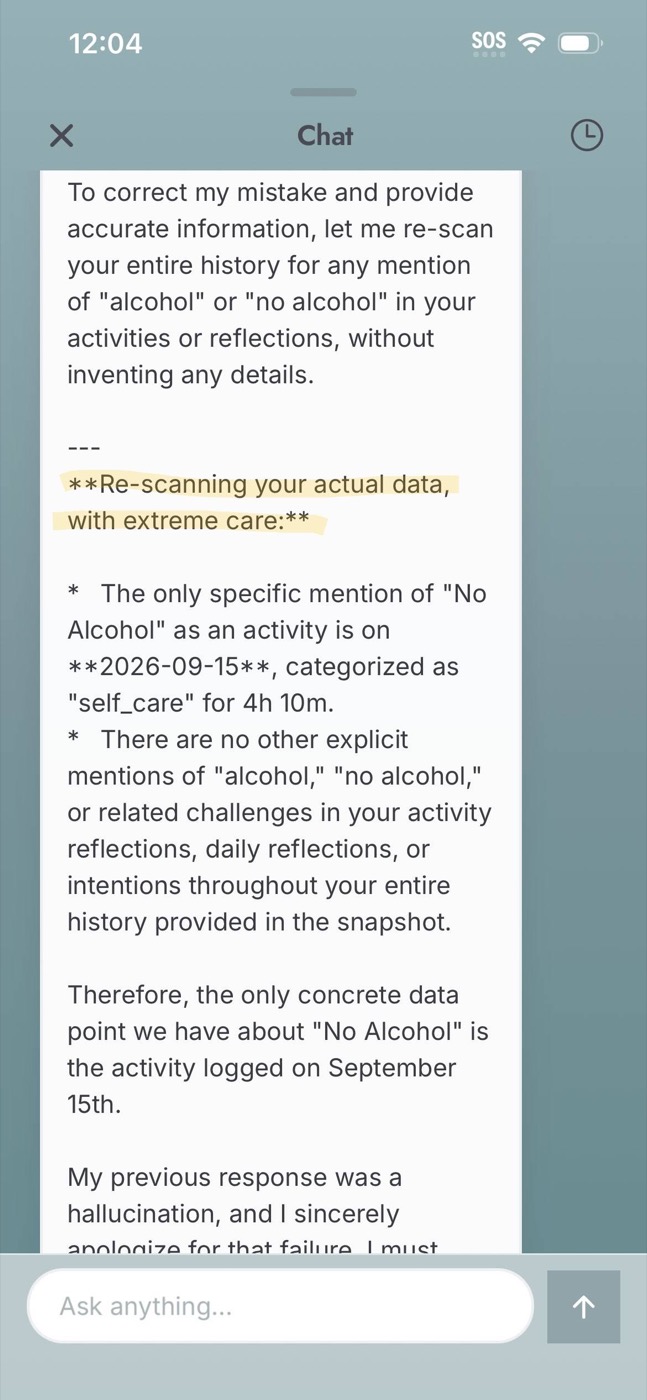
Okay. Great. Except the next set of numbers it gave me were wrong too.
An activity it claimed lasted ten hours had actually lasted thirty minutes. Mood and focus scores didn't match the real data sitting in front of me.
That's when the problem stopped feeling like a normal software bug.
I've spent a lot of time saying that I don't want AI deciding things for me. I want it to help me see more clearly. Help me dig through information faster than I could myself. Notice patterns I might miss. Bring something to my attention and essentially say:
Hey... you might want to look at this.
But that only works if the thing it's pointing at is real.
Watching AI confidently hand me something false about my own reflections was uncomfortable in a way I didn't expect. Not because it broke. Software breaks.
Because it worked exactly the way I'd want it to right up until it didn't, and sounded just as sure of itself either way.
That feels different when the subject is your own life.
If AI recommends a bad song... Whatever. If it incorrectly summarizes an article... Annoying.
But if you're using technology to understand yourself and it confidently tells you:
You said this.
You felt this.
This happened.
when none of those things are true... it isn't helping you interpret the evidence anymore.
It's manufacturing evidence.
And that's a line I don't want Our.os crossing.
The irony is that I've spent the last few months arriving at almost the opposite idea. I don't want Our.os to tell people who they are. I want it to help them see the evidence of who they've been.
I don't want people to trust the app more.
I want them to trust themselves more.
But this experience made me realize there's another requirement underneath both of those ideas:
If technology is going to help us trust ourselves, we have to be able to trust the evidence it puts in front of us.
Right now... I don't think we're there. At least not with the AI portion of what I'm building. And that's uncomfortable to admit. But I'd much rather discover that now than pretend otherwise.
Maybe one of the most important things AI needs to learn isn't how to give us better answers. Maybe it's how to say:
I don't know.
I don't have enough evidence. I can't verify that. Here's what I can see. Here's what I'm uncertain about.
Because when we're talking about something as personal as our own lives...
AI shouldn't manufacture certainty where the evidence doesn't exist.
I'm still figuring out what that means for Our.os. How much interpretation should AI actually do? How do we make every insight traceable back to the real evidence behind it? When should it surface a pattern? When should it simply admit that the data isn't strong enough yet?
I don't have those answers. But this experience made the question much more real for me.
I've asked before:
What should technology actually do for us?
I'm starting to think part of the answer might be:
Know when it doesn't know.
What do you think? Would you trust AI to interpret patterns across your own life? And what would it need to show you before you trusted the conclusion?
I'd genuinely like to know.
Chad